
Driven: 2026 Honda CR-V e:HEV RS
Anchoring an advertising creative on an LP Player on the roof of a car is gutsy stuff.
To the uninitiated, the LP pre-dated MP3. It even predated the CD’s that predated MP3. Picture a dinner plate sized vinyl disc with miniature circular groves on the surface. Within each groove are variations in pitch that are "read" by said needle, whilst the vinyl disc rotates at a constant speed.

Some say the sound reproduction of LP is unparallelled. But I’m not Kalthemusicguy, so let’s get to the point.
LP Players carried a major flaw in that the surface upon which it operated needed to be level and perfectly still. Any bumps or movement would cause the needle to jump; consequently, interrupting play and destroying the listening experience.
Few will know that CR-V stands for Comfortable Runabout Vehicle; a simplicity that is so beautifully Japanese.
Now in its 31st year of production, the market has seen 6 generations since the nameplates’ launch in 1995. Back then, it came to market owing to the humble Civic Platform. It was the EG Civic to be precise, and resultingly it deployed a non-vtec 2L B-series engine.
Honda’s CR-V was amongst the pioneers of the SUV world, signalling a seismic shift in vehicle design away from traditional sedans and wagons. It goes without saying that the market response was strong.
You can see the basic profile of the original; but the reality is most SUV’s look the same nowadays anyway. It’s a conservatively handsome design, with the Blazing Red Pearl of our top spec CR-V e:HEV RS doing a masterful job of highlighting the crease lines down the bonnet and sides.
Black highlights feature across the front end where the large grille is flanked by matrix adaptive led headlights. The theme continues down the side, where the gloss black finish extends to wheelarch trims and the rear-view mirror.

It may be the starkness of the contrast against the vibrant colour on this example, but I can’t help but feel this sort of design treatment makes the otherwise clean design look a little dated.
19-inch gloss black (for a change) wheels round out visuals and are wrapped in Michelin rubber.
Hitting the button to lift the rear hatch reveals 589 litres of usable boot space, which took 3 large pieces of luggage with ease. Despite searching extensively, no picnic tables were found though.
The second row can be folded down, which extends the space out to 1617 litres.

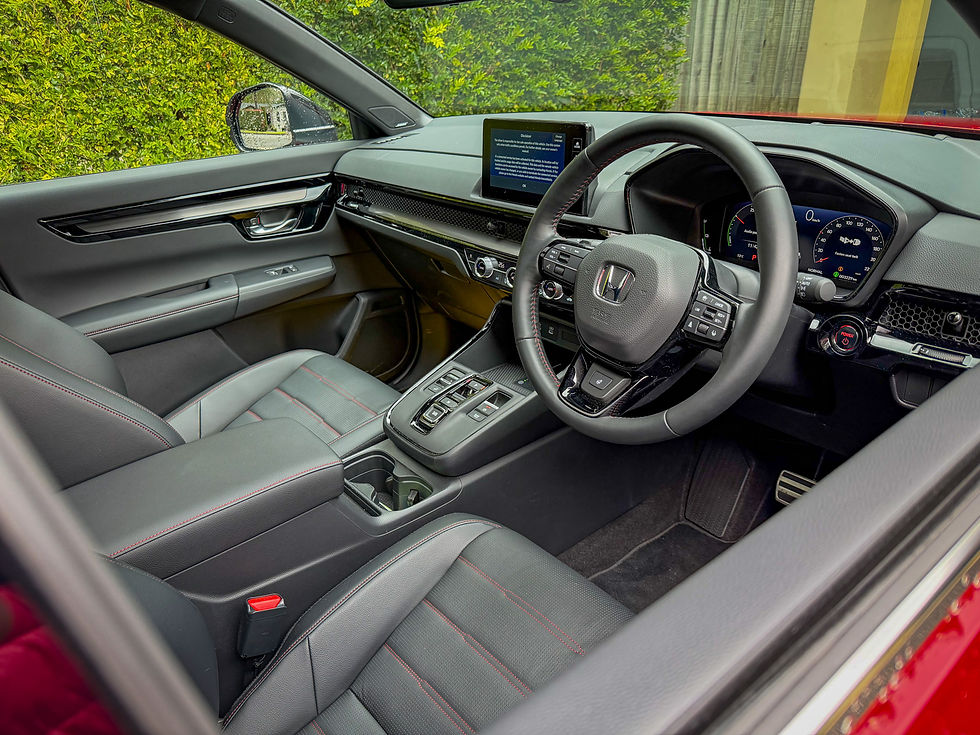
Climbing into the interior the first-time revealed elements that reminded me of the Accord. The dash had the same mesh trim across it, with similar toggles to adjust the hidden air-conditioning vents.
The driver and passenger seats offer a prudent blend of comfort and support, offering 10-ways of electric adjustability along with both heating and cooling. They’re covered in black leather with red stitching, a combination that extends across the cabin and bestows a sporty feel to the space.
Infotainment is through a 9-inch screen in the centre of the dash which runs a Google operating system, which means apps such as Spotify and Google Maps can be accessed directly through the vehicle.
Throughout my time with the CRV I simply couldn’t get Apple CarPlay reconnect when I’d leave and re-enter the car. In essence I had to forget and reconnect my device every single time. Wired options weren’t any better, this was a real blight on the overall experience.
The driver has their own 10.2-inch binnacle screen for vitals, along with a large colour Head Up Display.
Button-ware is all sensible thankfully, with major controls handled without the need to dig through the screen, but it was the gear selector that had me baffled. With the classic gear selector fast becoming a rarity nowadays, i've become used to different setups.
But the 4 buttons spread out vertically takes a simple thing and makes it complex. A gear selector, regardless of its location, is the kind of thing you should be able to manipulate without having to look at it.

This arrangement didn’t really allow that, certainly not over the course of 7-days anyway. A big plus was the fact that it would select drive and/or reverse without having to come to a complete and total stop. It sounds trivial, but it really frustrates me that some new vehicles require this; it makes fast movements unnecessarily difficult in my eyes.
Those buttons are connected to an e-CVT gearbox which can send power to all four wheels as required. Whilst I’m not a fan of CVT’s, this is the sort of vehicle where it belongs and makes sense. It does have an artificial “shift” which largely does away with the constant drone on heavy throttle application though. I guess beggars can’t be choosers.
Power comes from an Atkinson Cycle 2-Litre 4-cylinder Hybrid arrangement. It’s a clever setup that deploys a surprisingly small 1.05Kw battery which is continuously charged by a secondary motor within the gearbox.
The result is far more pure electric drive than I’d have expected.
Combined outputs are 135Kw and 335Nm, which aren’t exciting on paper, or in real terms. Despite this, the transition from electric to ICE is perhaps the smoothest I’ve experienced, and the combination maintains effortless forward movement regardless of the conditions.
Being a hybrid brings efficiency too, with fuel consumption landing at an average of 6.4L/100km, against an official number in the mid-5’s.
The quality of the ride fulfils the marketing promise described earlier too, with an impressive combination of poise and comfort. Through bends it sits remarkable flat; its confidence inspiring despite zero performance related intentions.

Damping is also a strong point. The 2026 CR-V RS makes light work of Sydney’s pimple-faced road network, with enough compliance to iron things out without feeling too soft.
The result is a serene and quiet cabin, where all occupants across both rows can focus on enjoying the drive (and the sunshine from the full roof sunroof), or their favourite tunes through the 12-speaker sound system.
The truth is that early in my time with the CR-V e:HEV RS, I felt pretty uninspired. I’m not sure why I carried any expectation into the loan period though, because it’s not designed to be anything other than a conveyance.
Ultimately the more time I spent behind the wheel, the more the engineering prowess and level of thought put into its design shone through.
This latest generation of the Honda CRV is a beautifully designed, well thought out and solidly built vehicle. At $64990 driveaway it’s not the cheapest, but for that ticket price you gain access to a vehicle that wears a rich history of quality on its sleeve.
Like: Beautiful ride characteristics, well appointment and built interior, Easy motoring
Dislike: CarPlay issues, that gear selector, a little meh outside
Car Guy Rating: 7.5
It took me a little while to “get” the CRV. But when I did, I became a fan (CarPlay issues notwithstanding). It’s simple and easy motoring with an overarching quality blanket across the whole caper that makes it a very easy thing to recommended. I wouldn’t buy it because I’d need more space for passengers in the coming year or two. Would Not Buy


Comments