
Launch Drive - MY26.5 Ford Ranger and Everest
How do you improve on market darlings like Ford's Ranger and Everest models? It's a perplexing question that's been answered by Ford Australia, with the launch of each nameplates MY26.5 mid-life update.
There's often good reason why a formula works, evidenced here by market leading sales performance for a few years running. If I was the shot caller, I'd be approaching things with kid gloves.
Clearly I wasn't alone in my thinking, because per my earlier article, this mid-term update is a careful regime of refinement rather than reinvention.
With the changes outlined previously, this piece will focus moreso on driving impressions. Ford's You Yangs Proving Ground, with it's multitude of testing facilities, was the perfect locale to sample variants across the range.
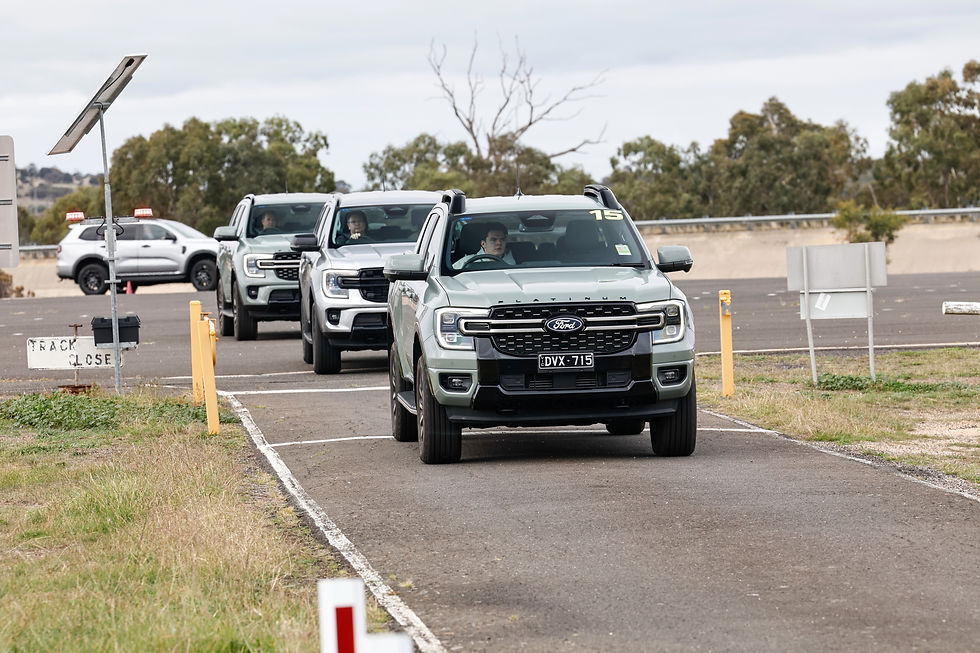
But before we got there, we were greeted by a gaggle of Everests in a hotel carpark not far from Melbourne Airport. With pleasantries and refreshments behind us, we were posed a challenge of a very different kind. I'm certain I wasn't the only one that has never been involved in a fuel efficiency challenge set by a manufacturer. The expletive-laced response was supposed to remain safe in the confines of my mind; it didn't.
The challenge made sense given that the long serving bi-turbo mill has been replaced by a single turbo diesel unit of similar capacity. Amongst other things, i'd imagine the intention was to demonstrate improved economy outcomes in light of the change.
With the promise of a trophy for the winner, we all hit the road for what was an hour-or-so trip out to You Yangs. With a blend of conditions afoot and two-up with a couple of day-bags on board, it was really hard to tell the difference between this and the old bi-turbo.
The engine is backed by a tweaked version of the familiar 10-speed auto, which works well to tap into the 405Nm of torque available from 1750rpm. Whilst torque comes in at the same RPM, the figure itself is almost 100Nm down on the bi-turbo. In these conditions though, there were no unnecessary downshifts to allude to any deficiency.
It was also just as quiet and refined at highway speed - fading into the background in what we know to be a well insulated and comfortable cockpit.
Despite doing our best, we weren't able to manage any better than 7.3L/100km on the trip to the proving ground, so there was no trophy for the mantel. The winner on the day saw a consumption of 6.2L/100km, an impressive figure that I simply couldn't figure out given we were coasting in neutral as often as we could.
Impressively, it's also a fair whack under Ford's quoted average consumption number of 7.1l/100km.

It was an entertaining exercise, but realistically, unless you're leaving these cars standard and driving like there is a $5 trophy at stake, real world numbers are likely to differ.
Spending time at the You Yangs Proving Grounds was certainly a surreal treat, but it was also the ultimate way to get a taste for how Ford conducts testing.
With the group split up, it was into a V6 Everest Platinum around the Constant Velocity track. This particular variant sees no change other than aesthetics, and remains the same excellent overall package as the one I reviewed recently .
With a steady 130km/h on the speedo, it was an entertaining doddle driving the Acacia Green SUV around this historic loop. It's amazing how slow that speed felt in these conditions, with the banks almost holding the vehicle in line with minimal driver input.
Next up was a run around a tar circuit in the infield, this time, in a 2L Everest variant. The route features a combination of conditions designed to emulate typical Australian country roads, complete with camber change, bumps and undulations designed to upset the chassis.

Despite the lead driver setting a decent pace, the test was handled well and was largely unremarkable, other than the acceleration. It was here that the deficit in power and torque versus the Bi-turbo became more noticable.
You will find figures on sprint times elsewhere. I wont put them here because they're simply not relevant for this sort of vehicle. What remains an unknown is how much impact a fully loaded vehicle will have on performance, let alone towing.
It's not hard to add multiple hundred kilos in frontal protection, roof racks and other ancilliaries design to support a touring build. This engine choice could become a far more pertinent issue for that intented usage.
The next test was a swerving manouver at speed. It's the type of thing you hope never to be forced to do, especially in a vehicle with such a high centre of gravity. The reality is that it did it and did it well. Kangaroos get awful big in the bush, and I often advise never to swerve, but the Everest had a confidence inspiring level of stability.

The final test of the day was across a range of offroad circuits. This was conducted in the new Wolftrack limited edition Ranger. Packing the V6 twin turbo diesel, the first challenge was at speed around a dirt circuit.
Again, not something one would do ordinarily - so it was nice to see how the various safety functions work without being so intrusive as to ruin the fun. A swerve and brake test further demonstrated chassis stability on dirt.
Finally, it was into high range with rear lockers engaged to get a feel for performance across various low speed off-road obstacles.
Most driving attributes across the Ranger and Everest remain unchanged, which is certainly not a criticism in any capacity. Both posess a continuing and prudent blend of comfort and capability, regardless of the conditions.
It's clear the biggest change is in the form of the "new" 2L 4-cylinder drivetrain option. The keyboard warriors will have axes at the ready to go all "tall-poppy", as they have done for many years.
As a daily driver, the engine option will be fine, and when driven with care it will clearly be frugal too. Without testing though, it's hard to tell how this drivetrain will go with a decent payload on board or when towing.
It won't matter as much in low range, but generally you need to drive on-road to get there.

At the launch it was made clear that Ford is continuing to expand their Ranger and Everest line-up to cater for various different market segments. If we stay with that notion for a moment, where you want a Ranger that's fast, you go the Raptor. If you want something that can cope with more payload and tow capacity for heavy work, you go the Super Duty.
By the same token when it comes to the more "garden variety" Ranger, you can choose the excellent V6 now, which is available across the range as an option.
Which leaves us with the 2L. Realistically it will be enough for the majority of everyday drivers who just want the occasional utility of a Ranger, or the size and comfort of the Everest.
Ultimately if you're wanting to big note your 0-100 km/h time, you're looking in the wrong place, if youre looking here.
Find out more about the Ford Ranger and Everest range at the Ford Australia website

Comments