
Forgotten Legends: Suzuki Swift GTi: The Little Japanese Hot Hatch That Became a Legend
There was a time when you didn't need a 300kW all-wheel drive with a turbocharger the size of a small family pet to have a genuinely exciting performance car.
I’m likely prodding the haters who label yours truly a boomer here, but there were far simpler times in the automotive world just a few (seemingly) short decades ago.
Today, very few would associate Suzuki’s Swift nameplate with any level of driving enjoyment, and rightly so. Because the current version of the nameplate is simply not worthy of said recognition.

But for a generation of Australian car enthusiasts, the GTi badge transformed Suzuki's humble little hatchback into one of the most entertaining performance cars on the market.
The late 80’s and early 90’s were the peak for hot hatches in my humble opinion. Whilst there were models such as the Twin Cam Corolla and Laser TX-3, it was the humble Suzuki Swift GTi that really took things to the next level.
It’s a legend that is now all but forgotten, and it deserves its time in the sun!
How it started…
The Australian Swift story commenced with the series 1 “SA” in 1984, which was in fact the brand’s first passenger-car foray on local shores. It was a platform that was also shared with Holden in the form of the Barina.
The Series 1 SA Swift/Barina was pure conveyance, and would’ve presented a real divergence for Holden at a time when the Commodore was king for the brand.
But it was the SA series 2, with its revised front end where the first GTi was born in the mid-to-late 1980’s.

It was out with the asthmatic 1-litre 3 cylinder "G10A", and in with the venerable "G13B" fuel injected, twin cam, 16-valve 4-cylinder engine.
It’s 74kW at 6600rpm and 108Nm at 5500rpm is laughable in today’s world. But a lithe kerb weight of 750kg endowed it with a power to weight ratio of just under 100kw/tonne.
Inside, it scored velour trim with red piping on the bucket seats, along with bespoke treatments across the steering wheel and other trims. It was otherwise unchanged, but this was inconsequential – because performance was the end goal.

Outside, it was differentiated from the garden variety Swift by a revised front bumper that featured driving lights, side skirts and a slightly different bumper up the back.
Underneath, suspension was stiffened up, whilst the front-end score ventilated rotors. 14-inch wheels are tiny by todays standard and wore a bespoke hub-cap (remember those?).
But it was the way the first generation Swift GTi drove that raised eyebrows.
I recall with complete clarity my uncle’s white example one evening, I was a wide eyed youngster in the passenger seat. I can’t remember the reason we were in the car, but I do recall the racket as he chased a Honda CRX up a twisty piece of road in Sydney’s north.
Years later that stretch of tarmac became affectionally known as “The Hillclimb” amongst mates. It’s called Dehli Road to the locals.
Then came the SF
But it was the second-generation Swift that arrived in 1989 that become the halo car of the 90’s.
The new SF-series was smoother and more rounded than the angular original, but Suzuki Australia hadn't abandoned the formula that made the GTi special.
The peaky 1.3-litre G13B remained in all its twin-cammed glory, continuing to be be backed by the same closely stacked 5-speed manual gearbox.

Power outputs were unchanged, but the SF was slightly larger and heavier than its predecessor, tipping the scales at up to 830kg. It mightn’t sound much, but it did dull the sprint to the tonne by up to a second depending on the source.
On that, an 8.5-9.5 second sprint is “slow dual cab ute” territory today. It wasn’t world beating at the time either, but it was never about that end number.
Inside it remained spartan but focused. Bucket seats sat low and commanded most of the cabin real estate. This wasn’t a 3-seater let alone a 5-seater in any way shape or form.
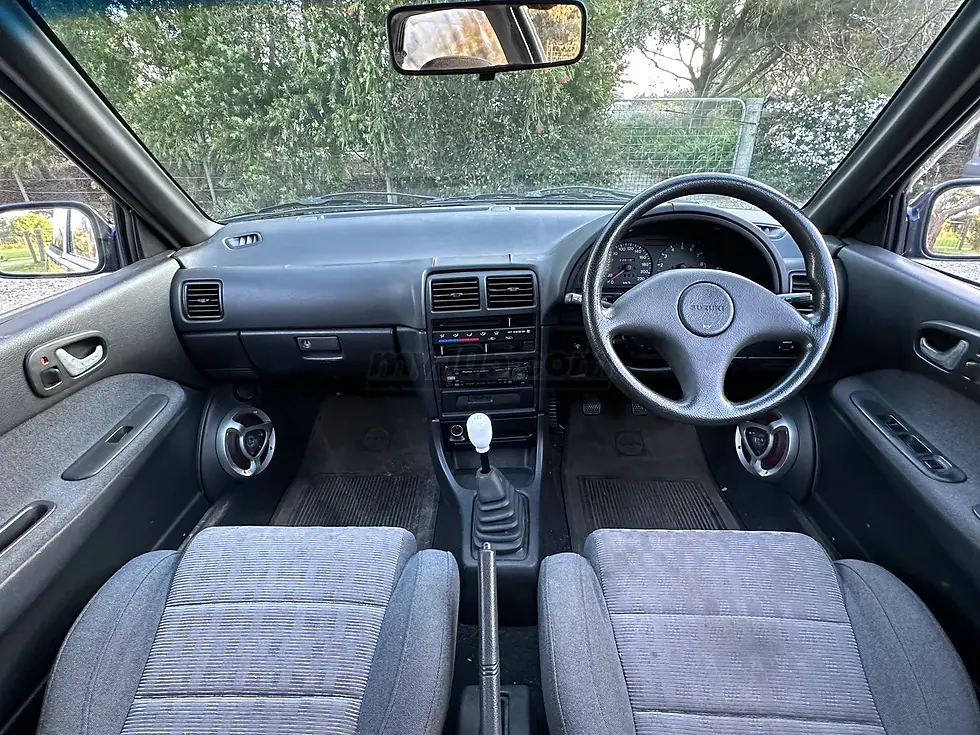
It was a metallic black variant belonging to a friend that I had the pleasure of piloting one night. With a license on the wrong side of validity, he threw me the keys given I’d become the unofficial designated driver at the time.
He wasn’t alone in this constabulary-related challenge at the time, given both the popularity and the performance on offer behind the wheel.
It’s way too far back to provide any detail with confidence, but ultimately it was the combination of size, resulting chuck-ability and the willingness of the powerplant that made it what it was.
Put simply, the Swift GTi made ordinary roads entertaining.
But it wasn’t just popular on the street…
One of the reasons the GTi developed such a strong reputation among enthusiasts was its motorsport pedigree.
This wasn't a road car that someone had decided would make a good race car. Rather, the Swift GTi was genuinely competitive in motorsport.
Internationally, the diminutive Suzuki competed in rallying and circuit racing, including Group A competition.
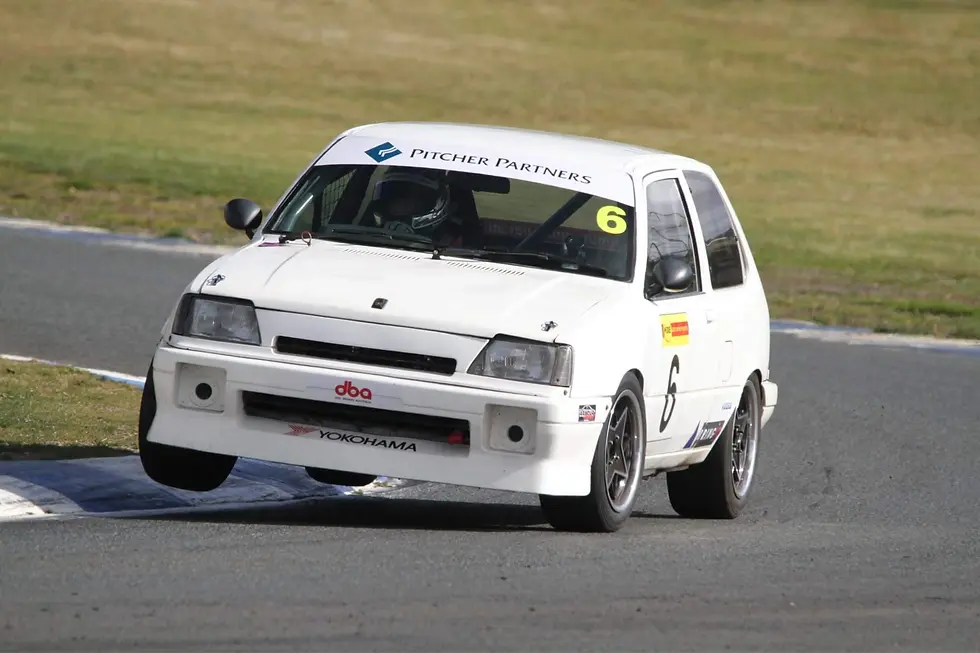
Closer to home, it was found amongst production car racing circles, rallying and club-level competition. The combination of low weight, rev-happy drivetrain and relatively simple mechanicals made it a willing candidate regardless of the persuasion.
But perhaps the most exciting was the advent of the GTi Cup in 1995. Run alongside the Australia Touring Car Championship, it fielded up to 32 identical examples across many of Australia’s most iconic circuits; from Mt Panorama to the long defunct Oran Park.

Sadly, the GTi Cup only lasted a single season after Suzuki's Australian distributor withdrew its support. But not before the already popular platform achieved cult status amongst motoring enthusiasts across the country.
Suzuki’s Swift GTi in the car scene...
Nothing excites a car-person more than a vehicle with motorsport pedigree. If you don’t believe me, just look at the prices being commanded by Ford Australia’s Falcon GT-HO.
But the Swift GTi was a different animal entirely.

It was the combination of performance and looks that made it one of the most popular platforms for modifiers in the early 90’s.
There was a period where you couldn’t buy a magazine like Hot 4’s or Fast Fours & Rotaries without a feature on one, nor go to an event without observing a handful of them in various states of modification.
Builds varied, with some as wild as complete mural paintjobs and wheelie bars (remember RBABY?) right through to the staple King springs on Auscar 5-spokes and a sport exhaust.

The last of a dieing breed...
But just like the car scene I described died, so did vehicles like the Swift GTi.
On reflection it was about the same time that brands like Toyota commenced on their journey to grow through more vanilla machines.
Suzuki has never returned to building cars like the Swift GTi, and as sad as that is, I can’t see it ever doing so.
The reality is it would be near impossible anyway. Cars like its Swift GTi were focussed on driver enjoyment; existing in an era where manufacturers weren’t burdened with today’s rules and regulations.
And that's why the Swift GTi deserves to be remembered. Not because it was the fastest car of its generation, because it wasn’t. Not because it had the most powerful drivetrain, because it didn’t. And certainly not because it had a long feature list.
What the Suzuki Swift GTi did was give ordinary people the opportunity to own something that felt special. It introduced countless young enthusiasts to modifying cars, motorsport and driving.
And it proved that you don't need huge numbers to have a great time behind the wheel.
The Suzuki Swift GTi may have been small small in stature, but for a generation of Australian car enthusiasts... it was a giant


Comments