
A Tale of Two Type R's: Honda Type R Showdown - FL5 Civic vs. DC2 Integra
I still remember the salesman’s’ words before he let me test drive it. With my late father by my side, I had to sign the sales contract with a “subject to test drive” clause; “because you’re going to end up buying it when you get back anyway”. Confident and ultimately true.
In retrospect, it was a move to ensure we knew that I owned it if I binned it – the sentiment was lost on me at the time.
Nevertheless, driving out of Scotts Honda in Artarmon on that test drive was surreal. It was a stack of cash, some $38,000 with a meagre trade-in; that’s about $80,000 today. The Integra Type R was a car I had done a fair bit of reading about, and enjoyed on Gran Turismo before the idea to buy one ever came about.
It was early 2000 and there was not a grey hair in sight. When I experienced the crossover many will simply know as “hitting VTEC”, I was blown away. It was the commencement of a love affair that has lasted 26 years.

Ownership has seen me immerse myself in the Honda community, court my now wife, refine my skills at track days and undertake countless late-night mental health drives. It has always been a reliable friend, regardless of what was happening in life at the time.
Honda’s Type R nameplate carries a long heritage of marketing factory-fettled vehicles with one outright intention: performance driving. As a result it has garnered a cult following across a broad cross section of society; from PlayStation pundits to serious collectors.
The badge is the ultimate expression of Soichiro Honda’s dream to build and race cars. A personification, if you will, of his ethos to utilise motorsport as a platform to refine and improve engineering outcomes for the brand's road going cars.

The badge launched in Australia in 1999 with the DC2 Integra Type R (DC2R), and despite a short local hiatus, continues today in the form of the FL5 Civic Type R (FL5R).
With a couple of glorious weeks planned in the latter, and the earlier on a trickle charger in the garage – it was a perfect opportunity to pit them against each other and see if the DNA remains.
The Old – 1999 Honda Integra Type R
Australia, along with much of the world, was a little late to the Type R party. Japan had the EK9 Civic Type R and NSX-R since 1995, but kept these machines to themselves. The first Australian deliveries of the DC2 Integra Type R commenced in 1999, a year or two behind the US, who saw a pre-facelift version that never made it to our shores.

The Frankenstein program started with what we knew locally as an Integra VTI-R, a good thing already. But an internal skunkworks team at Honda’s Suzuka factory saw it undergo an overhaul across almost every facet.
It was relatively subtle in terms of visual change to the VTIR, with the most obvious alterations appearing in the form of a front chin spoiler to compliment the iconic and oft-copied wing on the rear hatch. The combination was said to improve stability over 110km/h whilst reducing drag.
It was available in 4 hues, from the Sunlight Yellow (known as Phoenix Yellow in other markets) on this example, along with Nighthawk Black, classic Championship White and Milano Red. The latter solid finish didn’t fare well in the Aussie sun, resulting in oxidisation issues that often saw it referred to as Milano pink amongst enthusiast circles.
It scored a 5-stud conversion from the Honda Legend of the day which brought with it bigger discs and calipers, along with 15-inch lightweight Enkei alloy wheels which were wrapped in a specific Bridgestone compound.
The interior didn’t miss out either, despite possessing market-leading refinement for its time. The biggest deviation was found in the Alcantara trimmed Recaro SR seats. They were tight and supportive – a pre-empting if you will, of the cornering prowess available out of the box.

The driver hung onto a Momo leather-trimmed airbag wheel that was attached to a speed sensitive short-ratio steering box, along with a titanium gearknob. These two features made the DC2R a serious theft risk at the time, with the cost of replacements rendering a sad end in insurance auction houses for many examples.
The centre console featured slightly tacky faux-carbon finishes, but it was under the handbrake where you found the coveted Type R badge and chassis identification number, another piece that thieves loved to pocket.
Sound deadening was all but removed in a measure to reduce weight, along with a windshield that was claimed to be thinner than its VTiR brethren. Even the sound system and air-conditioning were omitted at the factory, only to be added back in locally by dealers.
Weight saving work continued right through to suspension parts, where specific aluminium lower control arms featured. The overall program resulted in a tare weight of a seriously lithe 1087 kilos, representing an almost 100kg saving on the VTiR. It also endowed the DC2R with a power-to-weight ratio that matched the Ferrari 355 of the time.
But it’s the mechanical and structural changes that really make the Type R what it is. The B18C1 becomes the B18C7 (or B18C5 depending on market) following a hand-rebuild; a laborious process that limited engine production to a total of 25 units a day.
The work included balancing and blueprinting, specific pistons with molybdenum rings, along with an upgraded oil pump amongst other things.

The result is a marginal increase in output to 141kw, but an engine that can be pushed safely to the 8250rpm official redline (and beyond) on the regular.
The gearbox is a treat to use, with a short and precise throw that almost prefers angry shifting. Inside the box, shorter ratios were installed to help keep within the VTEC powerband post 5700rpm, while a helical LSD helps to maximise traction.
Suspension revisions brought the chassis 15mm closer to terra-firma, with rigidity improved via extra welds in the engine bay and chassis seams, along with bracing underneath and across the front strut towers.
Whilst this example possesses mild period modifications, they’re all designed to amplify factory characteristics. Driving is the operative word; to get the best out of this car you really do need to drive it and drive it hard.
Turn in is lively and accurate and it will hold a line at as much pace as you’re feeling bold enough to carry. Mid-corner adjustability is a throttle modulation exercise, and it was on one night early in the ownership history that I learnt a valuable lesson. Thankfully we skirted any damage, but I never made the same mistake again.

Devoid of the gadgetry and soft landings of today’s cars outside of ABS, it truly represents a rawness that is simply not found anymore. Any ham-fistedness is mopped up by that excellent helical LSD, adding the confidence to throttle out of corners.
For me, when all the pieces come together it’s really a very hard car to beat for smiles – and it has taken on and conquered far more powerful machinery in various settings. Put simply it’s a legend.
A big call, and I do carry bias having owned it since new; but I’m also not the only one to bear that sentiment.
The New : 2025 FL5 Civic Type R
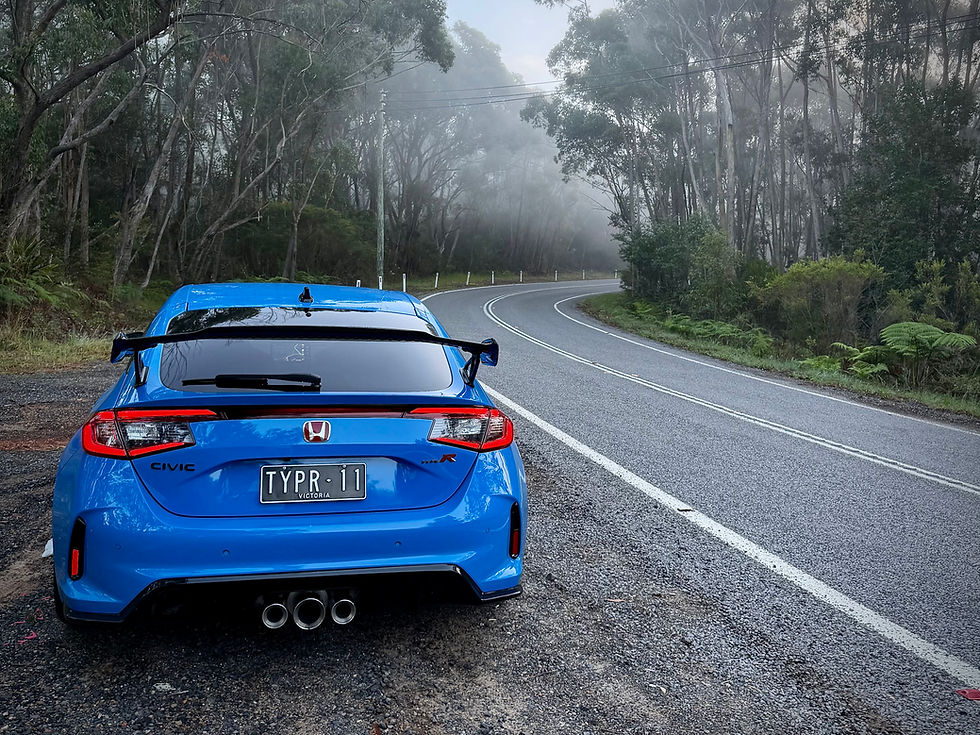
The metallic Racing Blue adorning the FL5 Civic Type R is just as ostentatious as its older family member.

It’s a far bigger machine that the DC2R, a function of time that’s evident across all modern vehicles. It’s a looker though, with the best angle being a front three-quarter view.
It’s the perfect vantage point to take in the 19-inch wheels and monstrous 265 section rubber. They fill the guards out well, with the perfect ride height and offset for an aggressive visual.
It’s also a good angle to take in the 88mm pumped guards complete with functional venting, and the aggressive, blacked out front lip and sideskirts. Up the back you get a huge carbon fibre wing, an optional part that will lighten your pocket to the tune of $6000.
It’s a masterclass in form and function; with an enlarged front grille and bonnet vent to aid cooling, tri-tipped and valved exhaust to maximise flow and manage sound, and those huge 4-pot Brembo brakes that struggle to hide behind the wheels.
You see the red bucket seats well before you even go for the door handle. Whilst they’re not Recaro’s like the DC2R, they are trimmed in Alcantara and offer impressive support and comfort.
The extra size was appreciated by this aging enthusiast. The also sit lower in the cabin too, another appreciated attribute when compared to the DC2R.

It’s a pleasant cabin to sit in, with controls that are perfectly placed for driving. This was a definite improvement over the DC2R, where the steering wheel feels too angled and the gear knob is a little too far away by comparison.
The FL5R misses out on a Momo steering wheel, and the gear knob is aluminium rather than titanium. Regardless though, each of these touchpoints are a pleasing nod to the past and satisfying to use.
The requisite screens across infotainment and driver binnacle exist, with CarPlay and Android Auto available in both wired and wireless form. Unfortunately, much like the original, the sound system was a bit of a letdown in the FL5R.
Perhaps the biggest deviation from the formula is also a benefit, because this is a 5-door hatchback. With surprisingly good space, it’s a genuine two adult affair in the second row.
This meant we could experience the car as a family, an unexpected but appreciated joy indeed. Whilst my daughters love the DC2R, I only ever ride with one of them given the space constraints.
Its also very composed and comfortable when potterring, which when combined with cabin space and the huge boot, makes this a very competent car to road trip in.
Under the bonnet we find the legendary K20, which goes way back to the DC5 Integra Type R. Outputs are markedly different to the natural aspirated units of that time, now reaching a staggering 315hp with a similar whack of torque too. Much of this can be attributed to the turbocharger strapped to the exhaust side of the engine.
Thats not to say that was a flippant move at all though, because there has been a range of adjustments and refinements to a whole host of hardware inside the engine.
I have to say that as a purist, until I got behind the wheel I sceptical of the use of forced induction.
A fortnight in various conditions revealed the power that I often missed in the DC2R. A 7000rpm redline means it doesn’t rev as hard, and you don’t feel any sort of Vtec crossover, but what you do get is a massive whack of torque that emulates that “high cam” crossover.
Truth be told its far more violent and brings with it a whistling soundtrack when the windows are down.
Shifting is by way of a close ratio 6-speed box with a lighter flywheel that more than matches the box in the DC2R for feel. In fact, its better, with short and precise throws that are aided by auto throttle blipping too.
Like the forced induction, this was a question mark to start with; heel-and-toeing is an inherent joy in the DC2R. I grew fond of it though, because it was always bang on and meant I could focus on steering.
On that note the steering is electric power assisted, with some measure of computer control. You wouldn’t know it though because the calibrations are perfect, with variable weighting that always has a lovely meaty feel to it.

Focus on weight was also a mantra in the FL5R, with resin used for panels such as the rear hatch and an aluminium bonnet up front.
Rigidity was also improved by adding reinforcements in the form of seam welds and bracing in the engine bay and chassis. It feels solid and planted, but not harsh - which is a credit to the team.
The FL5R also has driving modes; Comfort, Sport, +R and Individual. Each works its magic across suspension, steering, throttle and blipping and gauge layouts.
Hot tip, Comfort mode removes the fake engine noise plumbed through the cabin speakers. Thankfully Individual mode allows you to choose across all the adjustable attributes, so it was R+ across the board other than the engine sound.
But it’s in the way it drives where it all makes sense; in typical Honda fashion it’s all about the sum of the parts.
It feels like the DC2R – but with extra hot-sauce everywhere.
It bites hard on turn in, is flat and confident at speed through corners and feels delightfully benign and balanced, with no obvious over or understeer inherent in its personality. There is a level of confidence in this chassis that needs to be experienced to understand it.

Having said that, it’s also supremely playful – egging you on to push that little bit further. All the while, the right pedal is there waiting to catapult you to the next corner.
This is one of the most engaging, exciting cars I’ve driven in a very long time. It’s got all the bells and whistles and electronics that are required to sell a car today, but it maintains an uncanny analogue feel to the driving experience, which is very special indeed.
So which one is better?
I was very surprised to find the similarities between these vehicles; the heritage and DNA is most certainly there when behind the wheel.
The DC2R remains undisputably soulful; able to disappoint far more powerful cars and always put a smile on the face.

But The FL5R possesses the power that I’d wish for in the DC2R at times. The steering, the way it corners, the noises and feel you get out on the open road are all undisputably Type R.
At launch, the DC2R was a revelation, and was known as the best performing front wheel drive car for some time. The reality is, the FL5R carry’s that mantel and much more.
I was asked if I’d ever swap the DC2R for an FL5R. The answer to that is simple – and it’s a no.
That’s not because I think the DC2R is better, because in almost every single way it’s simply not. It’s not sentimentality driving the decision either, even though it exists in spades.
The reason why I wouldn’t trade it is because I simply couldn’t limit myself to just one.
Ultimately the winner here is people like us that love to drive. Cars like the FL5R are increasingly rare in a world that’s hell bent on numbing every sense.
I for one am thankful it continues to exist.
Long live the Type R
Like: A modern car with a decidedly analogue feel, seat/wheel/gearknob combination is perfect to use, An incredible drivers car with the practicality to use as a family
Dislike: I don’t own one
Car Guy Rating - 10
Honda has done a superb job of maintaining all the Type R DNA whilst building a vehicle that can comply with todays regulations. It’s a truly superb drivers car with the benefit of taking the whole family along for the drive. Although it was always at its best when driving alone on a deserted set of twisties. In a world where cars are increasingly digital and benign, even if they are far more powerful, Honda’s FL5 Civic stays true to the Type R ethos. We are all very lucky that its around. Would Buy.


Comments